 Trim My Crib™
Gulf air and your wood ceiling: sun, humidity and storm season
Outdoor wood under a roof has it easier than a deck, but it still lives in Gulf Coast weather. Here is what that means for finishes.
Updated · sources listed at the end
Why a roof helps so much
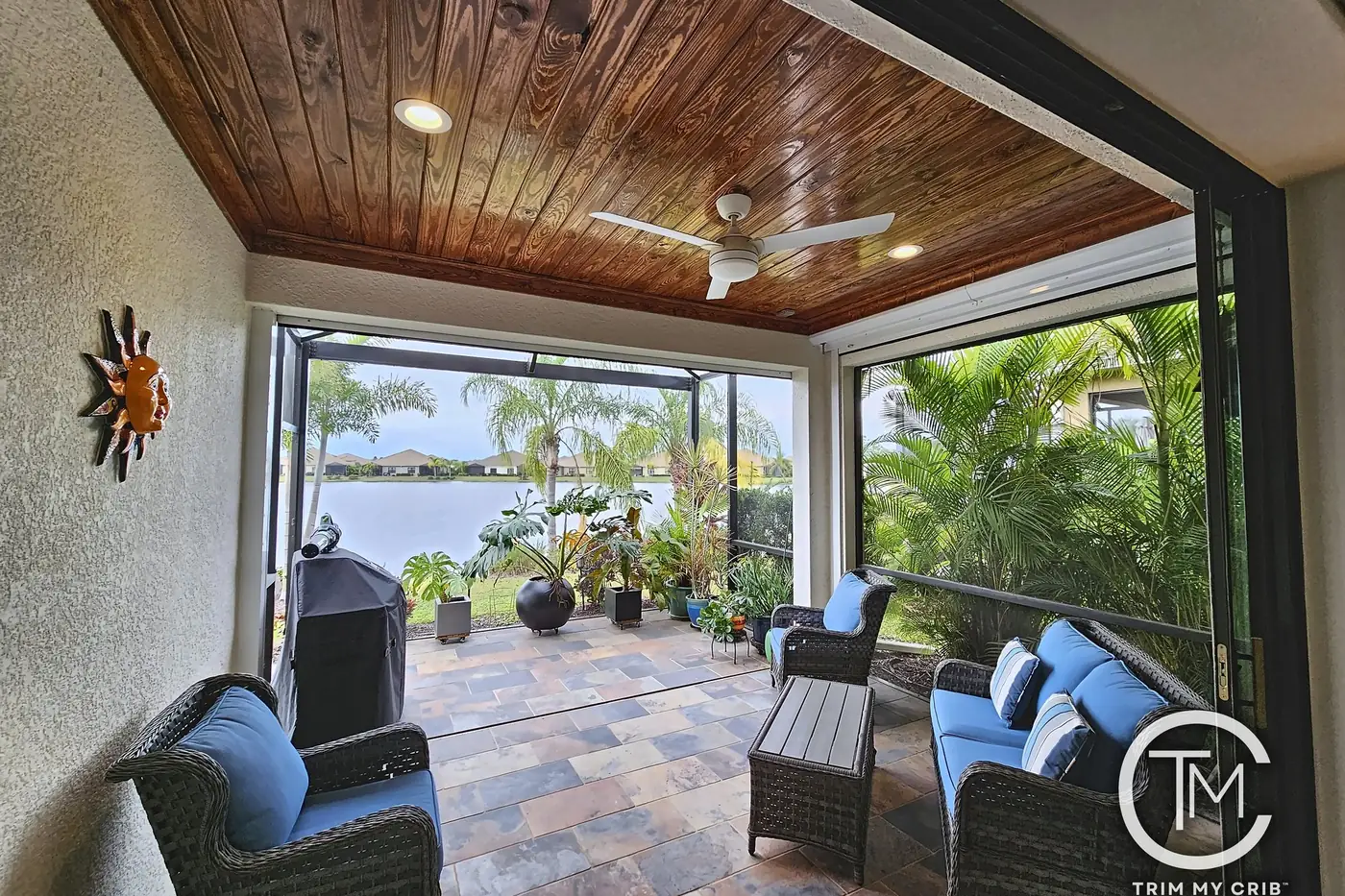
A covered lanai ceiling never gets rained on directly and stays out of most of the midday sun. That matters, because the federal Wood Handbook explains that sunlight and water are the two main forces behind weathering: ultraviolet light breaks down the wood surface and rain washes the damaged fibers away, which is why unfinished boards turn gray over time1. Under a roof, both are cut way down.
Which finishes hold up?
The Handbook groups finishes into penetrating types, such as semitransparent stains that soak into the surface, and film-forming types, such as paints and solid-color stains that sit on top1. It notes that pigment is what blocks sunlight: the more pigment a finish carries, the better it shields the wood from ultraviolet light1. A clear finish shows off the grain but gives the least protection where sun reaches it, so keep clear coats for well-shaded ceilings.
Humidity and movement
Wood takes on and gives off moisture with the air around it, swelling a little in damp months and shrinking in dry ones1. Tongue-and-groove joints and small gaps at the edges let boards move without buckling. On the Gulf Coast, outdoor boards should acclimate on site before they go up, so they start out close to the moisture level they will live at.
Storm season
The Atlantic hurricane season officially runs June 1 through November 30, with peak activity from mid-August to mid-October3. Before a storm, look for loose trim, open joints or water stains on the ceiling. After one, check for drips at the edges and near fans and lights. Water stains usually point to a roof or gutter problem, so fix the leak before touching up the wood.
Where the facts come from
- Wood Handbook: Wood as an Engineering Material (USDA Forest Service, Forest Products Laboratory, 2010), chapter 16 on finishing wood and how weathering acts on it. fpl.fs.usda.gov
- National Hurricane Center (NOAA), climatology of tropical cyclones in the Atlantic. nhc.noaa.gov